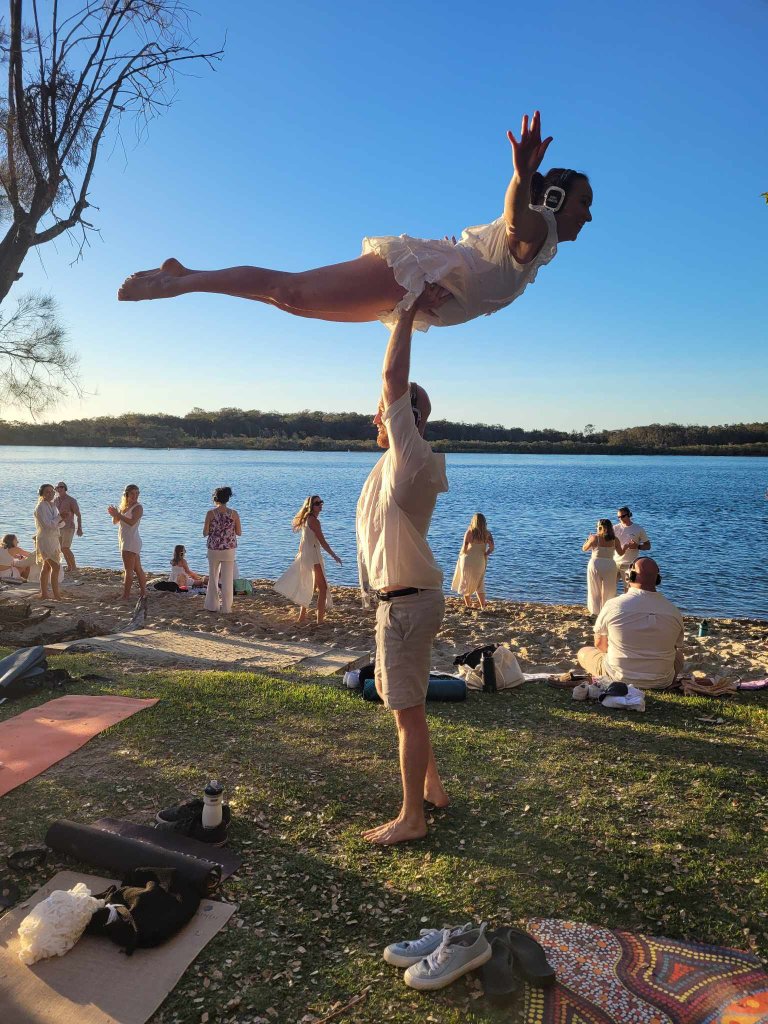
Practising partner acrobatics - one of the places play came back into my life.
Somewhere along the way, being busy became something to be proud of.
Exhaustion became evidence that we were working hard enough. Productivity became tangled up with worth, while rest and play became things we were expected to earn after everything important had been finished.
The problem, of course, is that everything is never finished.
There is always another email, another meeting, another load of washing, another person who needs something, or another task quietly waiting to replace the one we have just completed.
So we keep going.
We become responsible, capable and reliable. We learn to carry the mental load, manage the deadlines, show up for other people and keep everything moving, even when something inside us is beginning to feel increasingly flat.
From the outside, we may still look completely functional. We answer messages, attend meetings and do what needs to be done. We may even be praised for how much we manage to hold together.
But being capable is not the same as being well, and being productive is not the same as feeling alive.
At some point, many of us stopped simply living our lives and started managing them. We became very good at being human doings, while slowly losing touch with what it meant to be human beings.
The Capability Trap
The difficult thing about disconnection is that it does not always look like something is wrong.
You can still be capable, reliable and productive. You can answer the messages, meet the deadlines and be the person everyone turns to when something needs to get done. From the outside, you may even appear to be thriving.
Meanwhile, life can begin to feel strangely flat.
This is one reason high-functioning burnout is so easy to miss. We notice when someone falls apart, but we are less likely to notice the person who keeps functioning while becoming increasingly disconnected from their energy, curiosity and sense of self.
The world often rewards that capability, which makes it even harder to question. We are praised for carrying more, so we keep carrying more, even when we no longer feel fully present inside the life we are working so hard to maintain.
How Did Play Become Something We Had to Earn?
Play is often treated as childish, unnecessary or slightly self-indulgent.
It belongs to children, holidays and spare time. Adults are supposed to focus on serious things first and allow themselves to play later, once the work is complete and every responsibility has been handled.
That sounds sensible until we recognise that "later" rarely arrives.
When play is always placed at the bottom of the list, it quietly disappears from our lives. We stop experimenting unless we know we will be good at something. We stop moving unless it counts as exercise. We stop making things unless they are useful, and we forget how to follow curiosity without needing it to produce an outcome.
Play becomes something we think we have grown out of, rather than something we have simply become disconnected from.
That distinction matters because play is not just entertainment. It is one of the ways we connect, learn, regulate ourselves, create and discover what makes us feel alive.
Play is not the opposite of work. It is the opposite of shutting down.
I Did Not Need More Discipline
The Element of Play did not begin because I decided the world needed another framework.
It began because, after a difficult chapter in my life, I realised I was still functioning, but I was not fully alive in the way I wanted to be.
I did not need more discipline. I had plenty of that.
I did not need another routine, another productivity system or a better way to squeeze more into my day.
What I was missing was lightness, laughter, trust, curiosity and the freedom to try something without needing to get it right.
One of the places I began to find those things again was through partner acrobatics.
This sounds far more graceful than it actually was.
There was falling. There were limbs in strange places. There were moments when my brain was absolutely convinced that whatever we were attempting was a terrible idea.
There was also laughter, communication and trust. There was the experience of trying something, getting it wrong, adjusting and trying again. There was someone literally having to catch me, and the strange combination of feeling brave and completely ridiculous at the same time.
Somewhere in the middle of all that beautiful chaos, I remember thinking:
There I am. I feel like myself again.
That moment stayed with me, partly because it felt so good, but also because it raised a much bigger question.
When had I stopped feeling that way?
Play Looks Different on Everyone
The answer is not that everybody needs to start partner acrobatics.
Play is not one particular activity, and it does not require you to become louder, sillier or more spontaneous than you naturally are.
Some people find play through movement. Others find it through ideas, nature, humour, music, making things, solving problems, exploring somewhere new or having a conversation that makes them forget to check the time.
The activity matters less than what happens within you.
Does it bring you into the present?
Does it create a little more energy?
Does it help you feel connected to yourself or somebody else?
Does it remind you that you are more than what you produce?
Play can be small. In fact, when you are already tired or disconnected, small is often the best place to begin.
You do not need to find your passion, reinvent your life or add another elaborate ritual to your morning routine. You simply need to begin noticing the moments when something inside you softens, sparks or opens.
Those moments are not insignificant. They are clues.
Why I Created The Element of Play
I created The Element of Play because I believe many of us are tired of living as though our value comes from how much we can carry.
We have learned how to perform capability, but we have not always learned how to remain connected to ourselves while doing it.
The podcast is a place to explore what helps us come back.
We will talk about burnout, leadership, creativity, courage, movement, nature, nervous-system regulation and the small moments that help life feel like ours again.
Not because play solves everything, but because it gives us another way to meet our lives.
It invites curiosity where there has been pressure, experimentation where there has been perfectionism, and connection where there has been disconnection.
Maybe play is not something we need to earn.
Maybe it is something we need in order to remain human.
Maybe play is not something we need to earn. Maybe it is something we need in order to remain human.
Play of the Week
This week, notice one moment when you feel genuinely alive.
Not productive, impressive or pleased because you finally cleared your inbox. I mean a moment when something inside you softens, sparks or opens, even slightly.
It might happen when you laugh unexpectedly, hear a song you love, step outside, move your body, become absorbed in a conversation or forget to check your phone for a while.
When it happens, pause long enough to notice it.
Write it down if you can.
That moment is not random. It is information about what reconnects you to yourself.
When you begin collecting those moments, they can slowly form a map back to the parts of you that have been buried beneath responsibility, pressure and endless doing.
Perhaps the question is not only:
How can I get more done?
Perhaps it is also:
What helps me feel more human while I am here?
This article is part of Articles & Reflections from The Element of Play, Jodi Salmond's work exploring adult play, burnout recovery, playful leadership, self-connection and more human ways of living and leading.