We spend so much of our lives trying to be one thing.
Pick a lane. Pick a label. Decide what you are early, then spend the next few decades proving it.
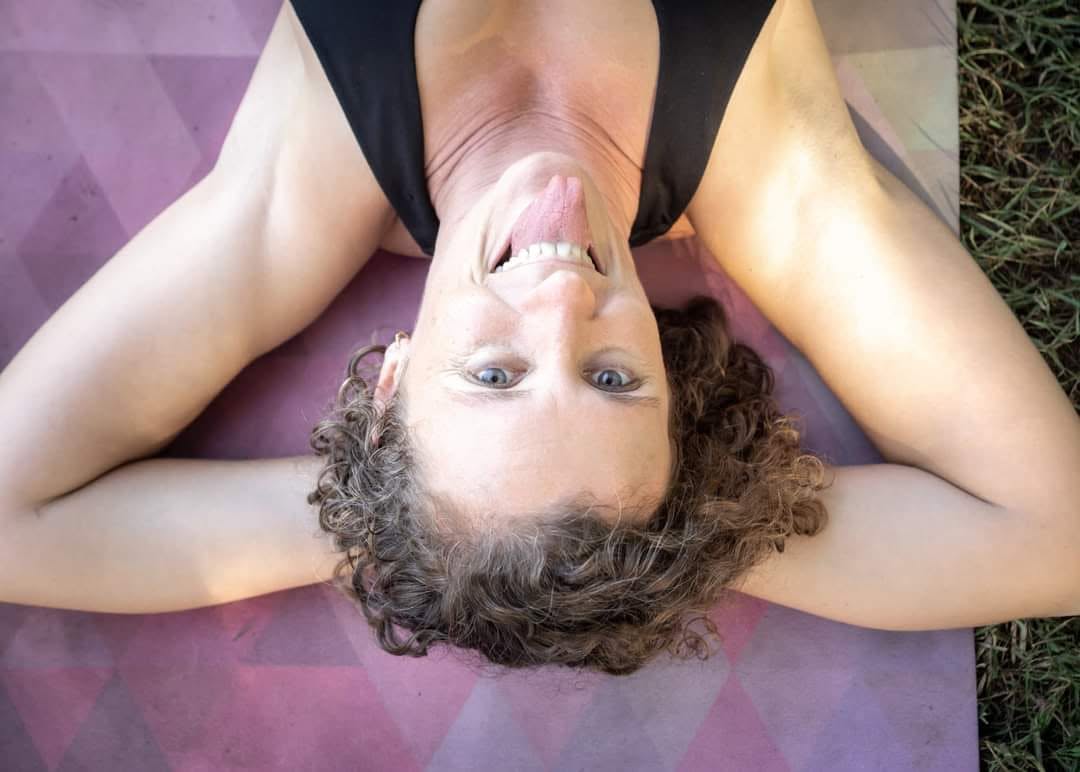
Gabriella Salmon decided that was exactly the problem.
I met Gabs years ago at a free partner acrobatics workshop in a park. I had no idea then how much that kind of movement, and that kind of person, would go on to change my life.
Gabriella describes herself as a multimodality, community and connection facilitator. A storyteller at heart. Her background spans percussion, vocal expression, creative writing, acro yoga and facilitation. She holds a degree in counselling and a graduate certificate in mental health and neuroscience. These days, much of her work focuses on community connection here on the Sunshine Coast, including creating platonic, non-erotic spaces for pleasure and connection.
Ask her to sum herself up in one line and she won’t.
She’s not dodging the question. The many-thinged thing is the point.
She calls herself a two-year-old in a grown-up body, and she means it as the highest compliment she can give herself.
The alchemy of curiosity and risk
Gabriella has a definition of play that I haven’t stopped thinking about since we recorded.
Play, she says, is the magical alchemy of curiosity and risk held in a safe space. Curiosity. Risk. Safety. All three matter.
There needs to be enough curiosity to make you want to explore, enough risk for something to actually feel alive, and enough emotional or physical safety to let you step towards it.
For me, that captures something important about adult play that we often miss. Play isn’t necessarily about games, silliness or having nothing better to do. Sometimes it is the moment you try something without knowing exactly what will happen. The conversation you allow to go somewhere unexpected. The movement your body has never made before. The question you weren’t planning to ask.
And perhaps that is part of why play disappears so quickly when our lives become too full. Gabriella said:
“I am yet to meet a person who’s perpetually busy who’s also deeply playful. They cancel each other out.”
- Gabriella Salmon
That line really landed for me. When I think back to the times I’ve been most depleted, play wasn’t something I consciously decided to stop doing. It was simply one of the first things that disappeared.
Curiosity went.
Spontaneity went.
Things became useful, efficient and necessary.
There wasn’t much room left for anything that existed simply because it felt good, interesting or worth exploring.
We talk a lot about burnout in terms of workload, stress and exhaustion. I wonder if another warning sign is the loss of curiosity. When we stop wondering. Stop exploring. Stop noticing. Stop asking what else might be possible. Maybe feeling alive has something to do with getting some of that back.
A different way of being with people
Looking back, I think part of why Gabriella had such an impact on me is that she didn’t just introduce me to acro. She introduced me to a new and novel way of being with people. More curious. More embodied. Less concerned with getting it right.
Partner acrobatics asks for trust in a very literal way. You are balancing on people, holding people, falling towards people and occasionally discovering that gravity remains annoyingly committed to doing its job. But there was another kind of trust developing too.
The trust to experiment. The trust to get something wrong. The trust to communicate what was happening in my body. The trust to let somebody else support me.
There was trust physically and emotionally, and I’m not sure I understood at the time how much I needed that.
Years later, I can see how much of what I now think about play, connection and embodied experience was quietly beginning there.
Being witnessed, not performed
One of the things Gabriella and I talked about was the difference between real connection and the performance of connection.
Her answer had very little to do with finding the perfect words. It was about consistency and a simple idea: All of you is welcome here. The shiny version. The messy version. The grumpy, uncertain, prickly, complicated version.
She talked about being witnessed rather than performing ourselves into acceptance. I’ve kept thinking about that.
We spend an extraordinary amount of energy managing how we are seen. Even in spaces that are supposedly about connection, there can still be this quiet pressure to arrive as the acceptable version of ourselves. Capable. Interesting. Fine.
I wonder how much deeper our relationships could become if we stopped asking, How am I coming across here? and trusted that we didn’t need to edit ourselves into belonging.
Because being witnessed asks something different of us. It asks us to let another person see what is actually there. That can be much more vulnerable than looking polished. It is also where real connection starts.
What the hard seasons taught her
Gabriella has lived through significant loss, including the death of her mother when she was thirteen, and a deeply difficult period during COVID that she describes as an identity collapse.
She spoke about feeling profoundly unheard around some of her own relational needs and about the despair she felt watching disconnection play out around her. But what stayed with me wasn’t simply that Gabs had survived hard things.
It was the role other people played in that survival.
People who were willing to question standard ideas about relationships, family and work alongside her. People who gave her space to explore different ways of being. People who reminded her that there were still humans willing to imagine something else.
She calls those people her sprinkles of faith in humanity. I love that. I think we underestimate how powerful it is to have people around us who make room for who we actually are. We talk about resilience as though it is an individual skill. Be stronger. Cope better. Bounce back. But sometimes resilience looks much more relational than that. Sometimes it is finding people around whom you don’t have to carry everything yourself. Sometimes belonging is the thing that makes continuing possible.
Curiosity as a practice
The thread running through our whole conversation was curiosity. Not curiosity as another self-improvement exercise. Just the willingness to ask one more question. Gabriella describes it as encouraging your inner two-year-old. That endless, unapologetic:
Why?
Why do I do this? Why does it have to happen this way? Why did that reaction come up in me? Why am I saying yes? Why am I saying no? What else haven’t I noticed yet?
There is something wonderfully disruptive about curiosity because the moment we genuinely ask why, the rules we have been unconsciously living by become visible. And once you can see a rule, you can decide whether you still want it. Maybe that’s one of the connections between curiosity, risk and play.
Curiosity opens the door. Risk is stepping through it. Safety, trust and connection give us somewhere to land.
Play of the Week
Gabriella’s whole conversation kept circling back to the practice of encouraging your inner two-year-old. Childlike rather than childish.
She asked:
“Where can you ask just one more question? Where can you go a little deeper into your emotions and feel a bit more? Where can you explore your surroundings, how you feel, what’s going on for you?”
So this week, pick one rule, assumption or ordinary moment in your day and ask why.
You don’t have to solve anything. Just get curious. Why do I always do it this way? What happens if I pause here? What am I actually feeling? What else might be possible? Let your inner two-year-old loose for a minute and see what turns up.
As Gabriella put it, be a little more curious in your decisions.
This article is part of Articles & Reflections from The Element of Play, Jodi Salmond's work exploring adult play, burnout recovery, playful leadership, self-connection and more human ways of living and leading.